The Cloud Security Data Engineer: Addressing Modern Cybersecurity Challenges Through Data Engineering

Abstract
"Security should no longer be perceived as a black art, but as a masterable, reproducible engineering discipline."
Traditional security tools are hitting a structural ceiling: alert volumes keep growing, resolution times remain high, and the reasoning behind most detections stays opaque to the analysts who have to act on them. This article argues that the root cause isn't just tooling, it's an organizational silo between the people who understand data and the people who understand security.
I propose a role to close that gap: the Cloud Security Data Engineer, someone who applies data engineering and data science to strengthen detection, while also applying security thinking back onto the data pipelines and models themselves. The article walks through the reasoning behind that proposal, a sample architecture for what it looks like in practice, the risks of treating ML as a pure solution rather than a new attack surface, and the concrete datasets, use cases, and sectors where this actually applies.
1. Introduction: The Limits of the Traditional Model
Most organizations have already migrated to the cloud, but Palo Alto's 2024 research [5] found that fewer than half of them actually have a solid grip on their own security posture. There's a paradox sitting at the center of that gap: the more security tools an organization stacks up, the less anyone seems to fully understand what's happening inside them.
The practical cost of that paradox is measurable. Per that same research, resolving a single security alert takes an average of 145 hours, and more than 60% of organizations need over four days to fully close out an incident. A purely reactive model has hit its ceiling. Moving toward data science applied to digital defense isn't a nice-to-have anymore, it's the direction the numbers are pointing to.
Industrial context worth keeping in mind:
A rapidly expanding attack surface across multi-cloud environments (AWS, Azure, GCP)
A global talent shortage of roughly 4 million cybersecurity professionals (ISC², 2024) [2]
An average data breach cost of $4.88 million USD (IBM, 2024) [1]
Generative AI making the problem worse: automated malware generation, hyper-targeted phishing campaigns, and authentication-bypass techniques (ENISA) [3]
2. The Real Problem: Tooling Symptoms and Organizational Silos
Most SIEM and EDR platforms today are, at their core, still rule-based systems with detection logic layered on top. This lines up with what Gartner's Security Operations Trends research has flagged as a persistent industry-wide pattern [4]. Beyond the 145-hour resolution average already mentioned, this shows up in two concrete symptoms:
Alert volume outpaces analyst capacity. Rule-based detection tends to flag anything that deviates from a narrow definition of "normal," which produces a high rate of false positives. Analysts spend a large share of their time triaging noise instead of investigating real threats.
Alerts are often a black box. A rule fires, an alert appears, but the reasoning behind why this particular event was flagged over another is frequently opaque, buried in vendor logic the analyst can't inspect or explain to their own leadership. Neither of these symptoms comes out of nowhere. Underneath both sits a structural problem inside most organizations: an artificial separation between the people who understand data and the people who understand security.
Data Engineers know how to move and shape data at scale (Python, SQL, Spark), but they're often disconnected from the threat models and compliance constraints that security teams live with daily. Security Engineers understand threats and compliance in depth, but are rarely equipped to build the kind of scalable pipelines that modern detection actually needs.
That gap has a real, measurable cost. SOC teams end up drowning in unstructured logs they don't have the pipeline maturity to process well. Data systems get built without security constraints baked in from the start, simply because the people building them and the people responsible for securing them rarely sit in the same room during design. The alert volume problem and the black-box problem are downstream effects of that same disconnect, not separate issues with separate causes.
This is the exact silo I'm positioning myself to close. Not as a data engineer who picks up some security awareness on the side, and not as a security analyst who learns a bit of Python on weekends. The Cloud Security Data Engineer role I'm proposing in this article exists specifically because this gap between the two disciplines doesn't naturally close itself from either side alone. It has to be someone's actual job.
3. My Proposal: The Cloud Security Data Engineer
I want to be upfront that "Cloud Security Data Engineer" is not yet an established job title in the industry. It's a role I'm proposing, built from what I see as a real gap between two disciplines that are usually taught and hired for separately: data engineering/data science on one side, and cloud security on the other.
My core thesis runs in both directions, which I think is what makes this framing useful rather than just another buzzword:
Data → Cyber: use data engineering and data science to strengthen threat detection, reduce false positives, and make alerts explainable.
Cyber → Data: apply security principles back onto the data systems themselves: the pipelines, the training data, and the models need to be defended too, not just used as tools of defense. The second direction is the one most articles like this skip entirely, and I think it's just as important as the first.
4. Why Data Science Became Necessary in Security
To understand why this proposal makes sense structurally, and not just as a personal career bet, it helps to look at how the exact same problem played out decades earlier, with spam.
Early anti-spam filters worked on fixed rules: block an email if it contains the word "Viagra," blacklist a sender's address, flag a suspicious subject line. It worked for a while, until spammers adapted within hours. Block "Viagra," they write "V1agra." Block an address, they create ten thousand more. Rule-based filtering turned into an endless game of whack-a-mole, because it was trying to counter an adaptive adversary with static logic.
The fix wasn't a smarter rule. It was a different approach entirely: instead of telling a system what a spam message looks like, show it thousands of examples of spam and legitimate email, and let it learn the difference on its own. That shift, from hand-written rules to learned patterns, is the same shift now happening across cybersecurity more broadly, in intrusion detection, malware classification, and behavioral analysis. Traditional, signature-based defenses are increasingly inadequate against attackers who adapt constantly; a data-driven approach that learns from evolving data is a more structurally sound response than trying to keep a rulebook up to date forever. This is the same logic behind the role proposed above: it's not a new discipline for its own sake, it's the natural next step in a pattern that's already played out once.
5. Data Engineering vs. Data Science: Who Does What
When I first got into this space, I didn't clearly distinguish data science from data engineering. I used to think of it as one blob of "using data for security." It isn't, and being precise about the split matters for anyone actually trying to build this:
Data Engineering is what makes detection possible at real-world scale: acquiring logs from multiple sources, cleaning and structuring them, building the pipelines that move data reliably from raw telemetry to something a model can consume, and keeping that pipeline monitored and running in production.
Data Science is what makes detection intelligent: feature engineering, training and validating the actual detection models, and evaluating whether they generalize beyond the data they were trained on. A model that performs beautifully in a notebook on a static dataset is not the same thing as a model running against live log volumes in production. That gap is exactly what data engineering closes. Neither discipline replaces the other; a Cloud Security Data Engineer needs a working fluency in both.
6. A Sample Design
This architecture isn't meant to replace SIEM or EDR platforms. It's meant to sit alongside them, closing a specific gap that rule-based detection consistently struggles with: distinguishing real threats from noise.
Take an open-source SIEM like Wazuh as an example. Out of the box, it already handles log collection, storage, and rule-based detection well. But like most rule-based systems, it tends to generate a high volume of alerts, many of which are false positives that a human analyst still has to triage manually. That triage cost is exactly where a data engineering and data science layer earns its place.
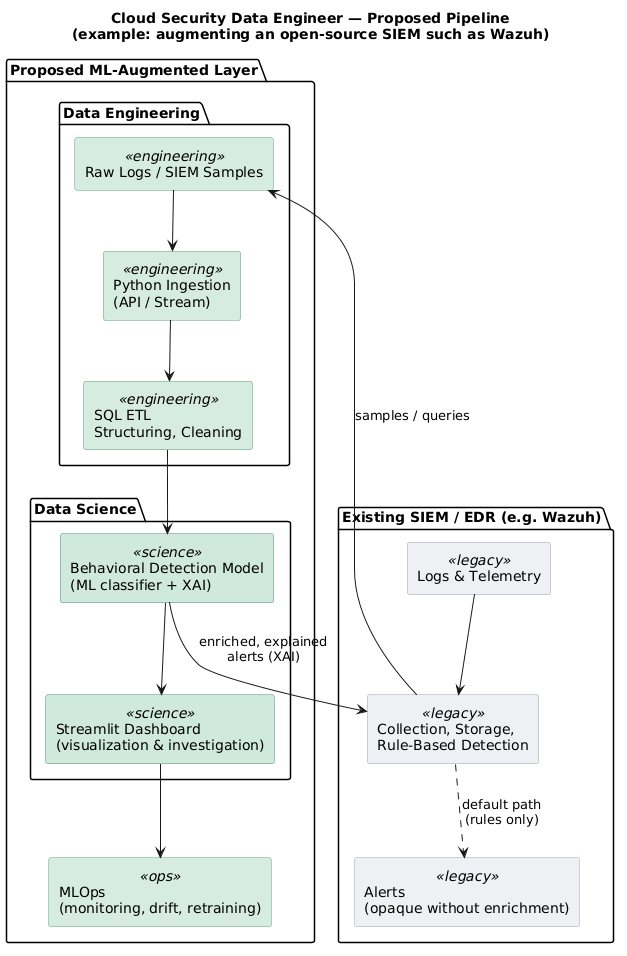
The proposed pipeline pulls a sample of raw logs and alerts from the SIEM, ingests them through Python (API or streaming), and structures them through a SQL-based ETL step. This is the data engineering half of the work, and it's what makes everything downstream possible at real log volumes rather than just in a notebook.
The data science half comes next: a behavioral detection model trained on that structured data, paired with an explainability layer (XAI) so an analyst can see why an alert was flagged, not just that it was. The result feeds back into the SIEM as an enriched, explained alert instead of an opaque one. The analyst still uses their existing tools, they just get a better-informed signal to act on.
To be clear about scope: this doesn't close the full gap with commercial platforms like CrowdStrike Falcon, which benefit from global threat intelligence telemetry and dedicated managed response services that a single pipeline can't replicate. What it does address is a narrower, well-defined problem: reducing alert fatigue and adding interpretability to detections, using open-source tools and a data pipeline built for that specific purpose.
7. ML as an Attack Surface (Not Just a Solution)
It's tempting to present machine learning purely as the fix for the black-box problem in security tools, but the model itself becomes something that needs defending. Two risks are worth naming directly:
Data poisoning: if an attacker can influence the data a detection model is trained or retrained on, they can degrade its performance or plant a backdoor that only activates under specific conditions.
Adversarial evasion: inputs can be deliberately crafted to slip past a trained model's decision boundary, exactly the way a spammer once learned to defeat keyword filters. Introducing a detection model doesn't remove the arms race between defenders and attackers. It just moves that race up a level, from rules to models. Mitigations exist (validating training data integrity, monitoring for model drift, adversarial training) but they need to be part of the design from the start, not an afterthought bolted on once the model is already in production.
8. Explainability at Scale
Explainable AI (XAI) isn't limited to simple tabular models. Techniques like Integrated Gradients, DeepLIFT, Layer-wise Relevance Propagation, and attention visualization all extend explainability to deep learning and even large language models. So the black-box problem isn't unsolvable, even for more complex architectures.
The honest caveat: these techniques get more expensive and less crisp as models scale up. Attention maps on very large models can become dense and hard to read, and methods like SHAP or Integrated Gradients grow computationally costly on long sequences or large vocabularies. In practice, this means the choice of model matters: tree-based models paired with SHAP give fast, clear explanations; deep learning or LLM-based components can still be explained, but at a real computational and clarity cost that should factor into the design.
9. Use Cases & Datasets
To ground this in something concrete rather than purely conceptual, here are use cases with real, publicly available datasets that a Cloud Security Data Engineer would actually work with:
| Use Case | Example Dataset | Source |
|---|---|---|
| Intrusion Detection | CIC-IDS2017, UNSW-NB15 | Canadian Institute for Cybersecurity, UNSW Canberra |
| Malware Classification | EMBER, SOREL-20M | Endgame Inc., Sophos/ReversingLabs |
| IoT Security | BoT-IoT, CICIoT2023 | UNSW Canberra, Canadian Institute for Cybersecurity |
| Threat Intelligence | OSINT feeds (text) | Various open threat-intel sources |
The threats these models would realistically target span the common categories security teams deal with daily: malware and ransomware, botnets, phishing and spear phishing, and, for the more mature end of a detection pipeline, the early signals of an Advanced Persistent Threat, where the goal isn't a single alert but noticing a slow, low-and-slow pattern over time.
Sector Applications
The same use cases don't carry the same weight everywhere. What counts as an acceptable false-positive rate, or an acceptable detection delay, changes a lot depending on the industry:
Finance: fraud detection and account takeover are the priority. False positives are costly here too, since blocking a legitimate transaction has a direct customer and revenue impact, not just an analyst's time.
Healthcare: ransomware is the dominant threat, and the cost of downtime is measured in patient care, not just dollars. Data privacy constraints (HIPAA-equivalent regulations) also shape what a detection pipeline is allowed to log and retain.
Government / Public Sector: Advanced Persistent Threats and espionage-driven attacks dominate. Detection needs to account for adversaries who deliberately stay under the radar for months, not just noisy, high-volume attacks.
Retail / E-commerce: bot traffic, credential stuffing, and payment fraud are the recurring patterns, often at very high transaction volumes where a data engineering pipeline that can actually scale matters as much as the model itself.
Critical Infrastructure / ICS: intrusion detection here overlaps with physical safety, not just data integrity, which raises the stakes on both false positives (unnecessary shutdowns) and false negatives (undetected sabotage).
10. Why This Matters: The Economics
The cost of getting this wrong is not abstract. NotPetya alone caused an estimated $10 billion in damages; WannaCry cost the UK's NHS roughly £92 million and led to 19,000 cancelled appointments; global cyber incidents were estimated at $945 billion in a single year [7].
On the other side of that equation is a thriving black market that makes attacks cheap to execute: ransomware kits can be bought for a few hundred dollars, stolen remote-desktop access for as little as $10-50 per server, and a zero-day exploit for a major platform can sell for anywhere from six to seven figures depending on the buyer. The asymmetry is stark: attacks are getting cheaper to run while their damage keeps climbing, which is exactly the kind of imbalance that data-driven detection, done well, is positioned to help correct.
11. Target Impact
The following figures aren't projections from an implemented system of mine. They're benchmarks reported in the academic literature on data science applied to cybersecurity, specifically "Cybersecurity Meets Data Science: A Fusion of Disciplines for Enhanced Threat Protection" [6]. I'm including them here as an evidence-based target for what a well-built pipeline like the one described above could realistically aim for, not as something I've already measured myself.
| Domain | Reported Impact | Source |
|---|---|---|
| Threat detection (zero-day) | 80-90% effectiveness | [6] |
| Incident response time | ~30% reduction | [6] |
| Vulnerability assessment precision | ~20% improvement | [6] |
| SIEM complex-pattern detection | ~40% improvement | [6] |
| Access control false positives | ~35% reduction | [6] |
12. Conclusion
Cybersecurity is a discipline where the attacker adapts continuously, which means static defenses have a shelf life. Data science and data engineering don't replace the fundamentals of good security practice, but they do offer a structurally sound way to keep detection adaptive rather than static, provided the systems built this way are held to the same security scrutiny they're meant to provide.
That's the double-sided idea I want to leave this article on: use data to make security smarter, and use security thinking to keep that data, and the models built on it, genuinely trustworthy.
13. Next Steps
This journey will be the subject of regular publications on this blog, following an open and pedagogical approach: presentation of concepts, project retrospectives (mini-SIEM, CloudTrail anomaly detection), and sharing of deliverables (notebooks, pipelines, dashboards).
I have already completed the CompTIA A+ training (IT Foundations) and the concepts of the AWS Cloud Practitioner (Cloud Foundations). I am currently developing three pillars in parallel: network mastery (studying CompTIA Network+), data engineering expertise (Python libraries: Pandas, Streamlit, FastAPI), and the mathematical foundations for ML (linear algebra, statistics, and probability). These acquisitions form the groundwork of my roadmap and confirm that I'm on the right path toward the expertise phase dedicated to cloud and data security engineering.
To Follow This Initiative
Find real-time updates on my LinkedIn
Access projects and demonstrations on my GitHub The journey toward a mastered, explainable, and data-driven cloud security posture is just beginning. It will be built here, in the open, documented and shared as it happens.
References
Hosen, M. et al. (2024). Cybersecurity Meets Data Science: A Fusion of Disciplines for Enhanced Threat Protection.
Maleks Smith, Z. et al. (2020), as cited in Hosen et al. (2024).
